Wednesday, 26 February 2014

Movie Review: Hot Fuzz (2007)


Hot Fuzz (2007)
Director: Edgar Wright
Cast: Nick Frost, Simon Pegg, Timothy Dalton


Edgar Wright is one filmmaker whom I have not quite followed, and to be honest, I was expecting Hot Fuzz to be nothing more than a farcical comedy. But the experience turned out somewhat differently. Yes, parts of the movie were truly preposterous, but they were intentionally and only superficially so. And of course, the film would not have been half as memorable without the wacky situations and wackier characters.

Nicolas Angel (Simon Pegg), a top cop in the London Police, is transferred to a quiet town called Sandford. Nicolas, initially upset about being forced to leave London, very quickly finds his feet and begins to perform his duties in the only style he knows.  Soon enough, he has rounded up kids for underage drinking, a policeman for drunken driving and ran around trying to catch an elusive swan (yeah, you read it right!). Suddenly, the events take a sinister turn when two actors are brutally slaughtered by a mysterious person who dresses up as the Grim Reaper. Angel is certain that it is a case of homicide, but the townsfolk think of it as an accident, and carry on with their normal life. But dead bodies continue to show up, forcing Angel to take the charge and investigate the matter with some assistance from a bumbling fellow policeman Danny (Nick Frost), even as all others keep turning a blind eye to the crimes to the point of driving Angel absolutely crazy.  As the two probe deeper, dirty secrets of Sandford begin to tumble out leading to a discovery which causes complete mayhem.

First things first, this film completely belongs to the two lead actors, Pegg and Frost. The two are in top form and their on-screen chemistry is arresting.  Pegg is the quintessential hero of the film – brave, righteous and most importantly, infallible. Still, he manages to make the character of Angel look eminently real. Frost plays the role of a good-natured cop who desperately wants to be a part of the ‘action’. But in a place as eventless as Sandford, he has to make do watching bad-ass cop flicks (Bad Boys and Point Break; there could have been better films for the purpose of paying homage, but I’m not really complaining) most of the time. He plays Danny Butterman with a charming innocence and warmth and his performance alternates between having us in splits and making us smile quietly at his child-like gullibility.  The development of the friendship between Danny and Angel is a key theme which adds to the emotional depth, which is so often found lacking in films belonging to this genre.

The plot runs at a feverish pace with hardly any time to ponder over the events. The editing, though very unorthodox, perfectly suits the tenor of the movie. Wright makes sure that his film does not become another spoof on the ‘slasher’ flicks, as the macabre death scenes, in spite of being cartoonish, create an atmosphere of suspense which is sure to keep the viewers guessing about the identity of the killer.

Like I said before, this is hardly a simple farcical comedy. The tone of the film is comic, rather cartoonish throughout with numerous pop culture references. But the emotional subtext provided by the budding friendship between Angel and Dan contribute greatly towards making the proceedings seem very relatable. Edgar Wright succeeds in making a hugely entertaining movie which so effortlessly blends a crazy plot with evocative social commentary.

Over-the-top, zany but not without substance, Hot Fuzz is a modern masterpiece which gives a whole new twist to the age-old concept of good versus evil. This is comedy at its best!


Tuesday, 21 January 2014

Movie Review: United 93 (2006)


United 93 (2006)
Director: Paul Greengrass


Conspiracy theories abound when it comes to what actually transpired during the morning of 9/11.  I have come across several articles speculating the causes behind the tragedy. These ranged from reasonable to utterly nonsensical.  But what is accepted almost unanimously is that the passengers on United 93 stirred up courage and stood together in adverse circumstances, possibly saving many lives and also inspiring others for years to come. It is this story of valour, driven out of desperation and the sheer instinct for survival, which forms the central theme of the Paul Greengrass movie.

On a seemingly normal sunny day, passengers board a routine flight at the Newark Airport bound to San Francisco. Unknown to the passengers, there are, in their midst, four terrorists who would stop at nothing to achieve their target. The flight take-off gets delayed due to high air traffic, and in the meantime the North Tower is hit by a flight 11. This induces shock and confusion in the air traffic control room as well as in the air command base as no one really knows what exactly is going on. It is only after a second plane hits the South Tower that the authorities get a whiff of the co-ordinated terrorist attack. They are too late in realizing that they are dealing with multiple hijackings. Alert messages are sounded off to all the flights but in vain, as another plane crashes into the Pentagon, while the fourth plane United 93 is successfully taken over by the hijackers. The moments following the take-over are gut-wrenching as we come face-to-face with our basest fear, the fear of death. Amidst this fear and turmoil, the passengers discover unity and courage and dare to fight back, very nearly managing to regain control of the cockpit. Alas, it is not to be. We know the rest.

The subject matter is extremely sensitive and even the slightest of errors on the part of the filmmaker would have ended up being labeled as exploitative. But Paul Greengrass has taken every care to make this film with utmost sincerity and sensitivity. He does not take any sides - neither are the terrorists glorified nor are the heroics of the passengers given the typical Hollywood treatment (read Die Hard). In fact, the portrayal of the terrorists as well as the innocent passengers is very impressive. The hijackers are not unnecessarily demonized and they are shown to experience anxiety and fear just like all others in the plane (for different reasons, though). The passengers simply seem to be ordinary people who unfortunately get stuck in a hellish situation. Many of the actors including the flight stewardesses and the people in the air traffic control, most notably Ben Sliney, play themselves in the movie, and this lends some level of authenticity and realism to the film.
The director completely decides to do away with character and development and nearly every character is given equal importance. There is no single person in the entire cast whose background is known and who is projected as the archetypical hero and this indeed helps in making United 93 stand out from other such films belonging to the genre. For the most part, we have the feeling that we are actually watching a real incident, that too from very close quarters. Greengrass makes you a part of the action and when the proceedings take a dreadful turn, it hits you hard.


The cast comprises of unknown faces that do not come with the past baggage of image and stereotype. And the performances of the actors hardly disappoint. In the last half hour, you see the proceedings from their point of view, and to their credit, their body language, demeanour and expressions make the tension palpable. Also, their transformation from being passive, frightened prisoners to finally deciding to take control of the situation is very believable.

The pace slackens a bit in the first hour with some repetitive scenes, but Greengrass' experience in documentary filmmaking holds him in good stead in the second hour. The unsteady camerawork, unconventional choice of actors and the knowledge that the events shown on film actually happened create a very disturbing and traumatic atmosphere. The scene of the sudden and violent take-over by the hijackers is particularly unsettling. The scenes that follow are no less distressing. But the last few reels make us root for the passengers and pray for their life even though we know how all of this ended.

Intense, and sometimes difficult to watch, United 93 is a heartfelt tribute to the unwavering human spirit, witnessed in the direst of situations. Watch it, but only when you are ready for it.

Thursday, 9 January 2014

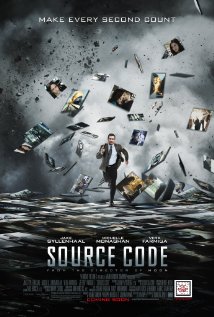
Movie Review: Source Code (2011)


Source Code (2011)
Director: Duncan Jones
Cast: Jake Gyllenhaal, Michelle Monaghan, Vera Farmiga 


Saturday night always brings up in me a desperate desire to watch pure and unadulterated escapist fare.  A quick sifting through the list of thrillers on IMDb made me settle for Source Code. At least it looked much superior to the recent spate of mindless action movies starring Nicholas Cage and Jason Statham. Thankfully, I was not disappointed!

The movie comes to the point in the very first scene. A commuter train in Chicago becomes the target of a terrorist attack, and is completely wrecked by an explosion. Before this tragic incident occurs, we are introduced to Coulter Stevens(Jake Gyllenhaal), who is perplexed by his presence in Chicago, because the last memory he has is of flying as an Air Force pilot in Afghanistan. Even more baffling is the fact that he is unable to recognise his own face. He begins to believe he is trapped inside the body of someone else! His beliefs turn out to be true when after the explosion, he finds himself in a pod, and Goodwin(Vera Farmiga) contacts him through video and explains to him that he is part of a the latest innovation in criminal investigation called Source Code which allows a person to be placed in the consciousness of another dead person in the last eight minutes of his life. The bombing of the commuter train had already taken place and it is left to Stevens to find out the culprit. He is repeatedly sent back into the Source Code but each time he ends up dead and in the pod. However, every time he goes back, he becomes more and more infatuated by Christina(Monaghan), a girl who seems to be in love with the person Stevens has taken over. Moreover, new truths about his life and the Source Code begin to tumble out. As he marches ahead in his search for the bomber, he also has to contend with the bitter realities of his own existence, his growing emotions towards Christina and the mind-games played by Goodwin's boss Rutledge.

Jake Gyllenhaal pitches in a very convincing performance as a person who is completely dazed to start with, but after spending time inside the source code and going through tough and demanding experiences, learns the importance of life, love and relationships. Gyllenhaal is equally adept in the tender and emotional scenes as he is in the action sequences. Michelle Monaghan as Christina is extremely likable(I instantly fell in love with her!!) and her innocence acts as the perfect foil to Gyllenhaal's gritty character. Vera Farmiga is splendid in her role as the duty-bound officer with a heart of gold.

The narrative structure is similar to movies such as Vantage Point, however, the premise here is very different. The incident of the train explosion is shown multiple times, however the difference in each scene lies in the manner Stevens tackles the problem and goes about his task of finding out the bomber. It is a novel technique of story-telling and is significant in raising the thrill factor of the film. 

Source Code is definitely not an out-and-out action film. Rather, it unfolds as a suspense thriller with the only problem being that a major twist comes a bit too early in the film and there are no significant revelations to follow it up till the very end. The ending, though intended to be a surprise, is never too hard to predict. 

Well begun is only half-done. Source Code starts with a bang and the director manages to maintain the thrill quotient till quite sometime. But the film loses some steam in the latter portions. The ending, though predictable, has a certain feel-good quality to it which is bound to make you come out smiling. Not the best thrillers to hit the silver screen, but the able performances and tight editing make Source Code rise above its shortcomings. With elements of action, suspense and romance in equal measure, this film is a worthwhile weekend watch.   

Sunday, 22 December 2013

Movie Review: The Good, The Bad and The Ugly (1966)


The Good, the Bad and the Ugly (1966)
Director: Sergio Leone
Cast: Clint Eastwood, Lee Van Cleef, Eli Wallach


Sergio Leone's films are often characterized by a majestic background score, stylized violence and an assortment of iconic characters. The Good, the Bad and the Ugly(GBU) is no different, and in fact, it was through the immense popularity of this movie that Leone's trademark style of movie-making became renowned. 

GBU is similar to the earlier films of the trilogy in terms of the treatment and setting, but it outshines its predecessors primarily because it is made on a much larger canvas with deeper themes, and the backdrop of the Civil War lends a touch of authenticity to the proceedings.  

The plot is very basic with hardly any complications. Clint Eastwood reprises his role of the detached, lonesome bounty hunter, always in search of means to earn some quick money. He meets Tuco(Eli Wallach), a wanted criminal, and a series of events follow which make them turn against each other. Tuco very nearly kills Blondie but fate comes to his rescue, as a carriage containing several dead bodies passes by. The lone survivor, Bill Carson, knows of some gold buried in a cemetery, and as luck would have it, Tuco ends up with the location of the cemetery, and Blondie with the name of the grave. The two men, previously at loggerheads, thus form an uneasy alliance to get hold of the bounty. But the two of them are not the only ones going for the gold, there's a ruthless murderer Angel Eyes(Lee van Cleef) hot on their trail. Through a series of misadventures, which sees Blondie and Tuco being taken in as prisoners-of-war and later, playing a part in the ongoing Civil War, the three of them reach the graveyard at around the same time leading to a thrilling finale(a Mexican stand-off!!).

When it comes to acting, Eli Wallach as Tuco steals the thunder from under Eastwood's feet as he delivers a knock-out performance, and is the source of vivacity in the plot. He plays out the role of a bumbling criminal in the most natural and effortless manner. Initially, his character appears to be very detestable, but towards the end, the viewer bound to develop a soft corner for him despite all his shortcomings. In this sense, it is a very well fleshed out character and the only one whose background and motivations become known to the viewer.

Due to credit must be given to Eastwood though, as his is a severely underwritten character, but he manages to infuse enough style and substance to deliver an admirable performance. After all, none of the Dollar films would have been what they are without The Man With No Name. Lee van Cleef has very little screen time but excels in evoking disgust and revulsion from the viewer.

The background score can easily be called the fourth character in the movie, such is its significance. Ennio Morricone deserves every bit of acclaim for creating a wonderful score without which the film would have been incomplete. It is rumoured that Leone decided on the music before he filmed the scenes. This technique, though unorthodox, works pretty well in this case.

The cinematography is first-rate, with a fine mix of long shots and close-ups. The scene where Tuco escapes from a train and Mexican stand-off sequence are filmed with finesse. Considering the fact that the  film came out in the sixties, this is a monumental achievement.

Sergio Leone creates a visual masterpiece in the form of The Good, the Bad and the Ugly. The scenes, the music and the characters are bound to remain etched in the minds cinema lovers forever. Despite its excessive length, the movie does not cease to captivate even for a single moment. This is not just a bounty hunting adventure set in the West, it is a breath-taking saga of friendship, trust and loyalty, and if you have followed the plot and the characters closely, you would not be surprised with the outcome of the final shoot-out. Highly recommended!

Friday, 28 June 2013

Movie Analysis: The Machinist (2003)


The Machinist (2003)
Director: Brad Anderson
Cast: Christian Bale

WARNING: Spoiler alert


I felt after watching The Machinist that a review would not really serve any purpose because I cannot discuss a lot of things about the movie without letting out any spoilers. Even elaborating on the themes touched upon in the movie would very well mean letting out the suspense. So for all those people who have not seen The Machinist and have come here expecting a review, I can only say that this is a riveting psychological thriller that will keep you engrossed well after the credits have rolled down, and yes, please DON'T read any further!!

On the surface, The Machinist is simply the story of an insomniac, who, following some intriguing series of events begins to doubt fall apart, with everyone, including himself, starting to doubt his sanity. But as one goes on watching the movie, many doubts crop up. Firstly, why are the things that are happening to Trevor(Christian Bale), whether in real or in his mind, actually happening to him? Secondly, why does Trevor look so severely emaciated and unhealthy, and why has not he been able to sleep for a year? The answer to these questions, as we finally realize, lie in the past. For this is not just a story of madness and sanity, it is a much deeper tale of crime, guilt and redemption.

Trevor can easily be the subject of a case study in psychology, such is the depth and character provided to him by Bale. He is a man torn apart by the guilt of accidentally running over a child, and it is this guilt which has been pricking his conscience to such an extent that he has not even been able to sleep peacefully for over a year. 

WHAT REALLY HAPPENED:
A year before the events in the story, Trevor, while trying to light his cigarette in a moving car, moved his eyes off the road, causing the tragic death of a young boy. He quickly drove from the scene of the accident and destroyed his car. Though he escaped punishment by law, he could not escape his own conscience. He lost his sleep and started to become increasingly weaker. From the time the events in the film are shown, Trevor has already become so weak and thin that he has begun to look severely emaciated. 

WAS HE ALWAYS A MACHINIST?
Before the life-changing accident occurred, Trevor used to work in the same factory but as can be made out from his photograph with Reynolds and also from the conversation between the workers in the initial scenes, he was much more outgoing and sociable. Whereas, after the tragic incident, he had become quiet and withdrawn. His relationship with Reynolds had also clearly deteriorated, as they hardly ever indulge in any fruitful conversation during the film.

WHO IS IVAN?
Consciously, Trevor had forgotten the incident, but his conscience was still disturbed by what had transpired a year ago. Ivan was a manifestation of himself and his ugly past. He used drive the same car which Trevor had destroyed after the accident. The strange and repulsive physical appearance symbolized the sin he had committed. His presence seeks to remind Trevor of who he actually was - a killer. In the end, when Trevor turns himself in, we see Ivan smiling in acknowledgement, which goes to show that he had achieved his true purpose, and Trevor could finally sleep in peace, without his haunting presence.

MARIE & NIKOLAS :
Marie and Nikolas were also a figment of Trevor's imagination, whom he had created in order to lessen his sense of guilt. Nikolas, in fact, was the child who was killed in the accident and Marie, his mother. Developing an endearing bond with the both of them was his way of lightening the burden of guilt and also of proving to himself and his conscience that he is a much better person than what he has actually turned out to be. 
Another point to be noted is the fact that the time shown by the clock during all of their meetings is 1:30, which also happened to be the time of the accident. Also, the amusement park was a place Trevor had previously visited with his mother. What this proves is that every meeting with Marie and her son was a dream with the detailing done by Trevor using his own memories.
Another reason for the aggravation of his tremendous guilt were the fond memories of his late mother, and the realization that he was responsible for breaking an equally cherished relationship between Marie and Nikolas.

ROUTE 66:
The ride in the amusement park was another trip down the troubled psyche of Trevor, the grotesque imagery representing the guilt-ridden and tormented state of his mind. In his dream, Nikolas was driving the car, but actually, it was his conscience that was driving this journey, and that is probably why it took a turn towards the Highway to Hell when there was the choice of going towards the Road to Salvation. Subconsciously, he found it impossible to forgive himself for what he had done.

THE REFRIGERATOR:
The refrigerator too has been given special emphasis in the movie. The notes in which the game of hangman plays are all stuck on the refrigerator. Although initially it is implied that the notes are being put there by some unknown person, it becomes clear at the end that the notes were stuck by Trevor himself, not consciously perhaps, but he was most definitely driven by his guilt to stick those notes which eventually label him as a 'KILLER'. 

THE IDIOT:
At various points in the film, Trevor is shown reading  Fyodor Dostoyevsky's The Idiot. Coincidentally, Dostoyevsky is a writer famous for exploring human psychology through his works and not very surprisingly, the most novel by him is called Crime and Punishment. Besides the symbolism, the scenes could well be the director's way of paying homage to the writer. 


DID TREVOR REALLY NOT SLEEP FOR A YEAR?
Sleep deprivation for over a year is next to impossible physically, which leads me to conjecture that Trevor actually did sleep, only that he never came to realize it. This was probably because thinking his dreams to be true. If the film is watched closely, it can be observed that Ivan appears whenever Trevor attempts to catch some sleep. In reality, it could be that Trevor has actually fallen asleep and Ivan is a part of his dream. Moments before Miller loses his arm, he tells Trevor off for sleeping, though it appears to us that he is watching Ivan work. Moreover, when Trevor halts his truck bang in the middle of the road, the scene quickly cuts to the airport where he is chatting with Marie. The scene at the amusement park is also preceded by a shot of Trevor looking intently at a cup of coffee. It is quite possible that at all these times, Trevor inadvertently dozes off and starts dreaming. However, he is too distressed and disoriented to distinguish between dream and reality. 

Through this analysis, I have attempted to touch upon all those aspects about the plot and the theme of The Machinist that came to my mind. This is a very well-made film, though not as complicated as it appears at first. But the director does well in the sense that after the final plot twist, every minute and apparently trivial events which occur before in the movie attain considerable significance and can be easily related to the larger picture.For example,the hit-and-run accident in which involves Trevor victimising himself intentionally seems crazy at first, but when we come to know of his back story, the incident attains tones of dramatic irony, more so if we consider the fact that the vehicle was being driven by a woman with her child by her side (poetic justice, anyone!!).

Christian Bale is truly emerging as the perfectionist among the current generation of actors. The extent to which he achieves the required physical appearance of his character is remarkable, and equally astounding is his performance that easily ranks among his best. 

The Machinist is a taut, relentless story of crime and salvation which induces a sense of fear and foreboding in the viewer not by means of unnecessary gore and cheap thrills but through a dark and cheerless setting backed up by some intelligent camerawork. From this perspective, The Machinist is very much Hitchcock-ian in terms of treatment and thematic content. Though it certainly does not make for an easy movie-watching experience, The Machinist is one of the most captivating psychological thrillers in recent times.